

Put together the team’s principles
During your activities as a Service Desk Manager, you start to know the basic human behaviors that drive your team’s success. It is important to identify them as they may seem obvious and not more than common sense to you. Even then, do take into account that the factors you consider being normal are often not that straight forward for other team members.
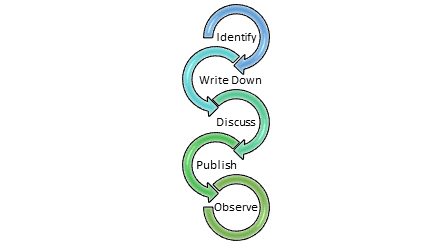
Once you have identified a principle you need to write it down. Many leaders and managers take ideas and statements more seriously when they are written down. In case you plan to use it later, provide sufficient context so your principle can ripe and mature.
When you have worked out your principle it is time to submit it to the attention of your team. Discuss why you believe the principle forms an important behavior of the team and ask if they support the rationale behind it. Various reasons like culture and education make people think differently, so there is chance that not every team member is convinced at first. Principles often refer to the companies values, use this association to gain acceptance. Finally, when there is a broad consensus, don’t forget to publish the principle.
Publishing the Service Desk’s principles means that everybody of the team agrees upon the execution of the expected behaviours to maximize the success of the Service Desk. They know where to find the collection of principles that are used in the Service Desk.
The principles act as a guide or a (moral) compass in new and/or ambiguous situations. They help your team members in taking decisions. Principles are also valuable in relation to continuous (service) improvement.
When you notice at any point that a principle isn’t respected in the team, discuss it again as soon as possible. Adjust the principle if there are good reasons to deviate from it, or revoke it when it doesn’t have any longer the support of the entire team.
You can work with your team around principles each time you idenfy one, or hold a brainstorm or workshop to identify and discuss several principles at once.
Example(s)
We noticed that a lot of incidents processed by the IT Service Desk didn’t meet the required service level target: the tickets were resolved too late, mainly because the team didn’t manage to follow up on them on a regular base. The idea was put on the agenda (written down) for the next Service Desk team meeting. After a brief discussion we agreed:
- to create a dedicated queue in our service desk tool that lists all tickets in a waiting state,
- and that each team member will review and update these tickets on a daily base.
The “Daily follow up” principle was added to the other existing principles in the Service Desk Handbook. It is as easy as that.
Some other Service Desk principles our team maintains:
- “The human touch”, about user empathy…
- “Learning on the fly”, learn by doing, continuous learning…
- “Take ownership”, push your tickets to the end.
The 7 guiding principles in ITIL 4
In the above section we gave our advise to define the existing principles inside your Service Desk team that can be used as a guidance when necessary.
Adjacent to yours (or vice versa), ITIL has also defined 7 general guiding principles to take into account when working in a service environment:
- Focus on value
- Start where you are
- Progress iteratively with feedback
- Collaborate and promote visibility
- Think and work holistically
- Keep it simple and practical
- Optimize and automate
More information about principles
If you want to read a lot more about principles, there is an entire book dedicated to it: “Principles“, from Ray Delio.
Categorieën:Team Service Desk


Geef een reactie